





Deskdex

For the Pokémon Trading Card Game

What your cards are worth, and where the number came from.

Deskdex prices your Pokémon collection from the marketplaces' own published figures. Every number says which marketplace it came from and the day it was read.

Free. No account to start, no ads, no tracking. Put it on your phone

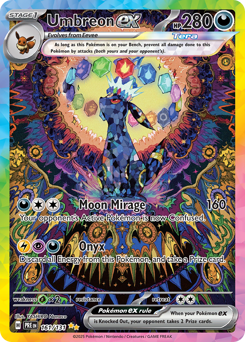
Umbreon ex, Prismatic Evolutions
Charizard ex, 151
Pikachu ex, Surging Sparks
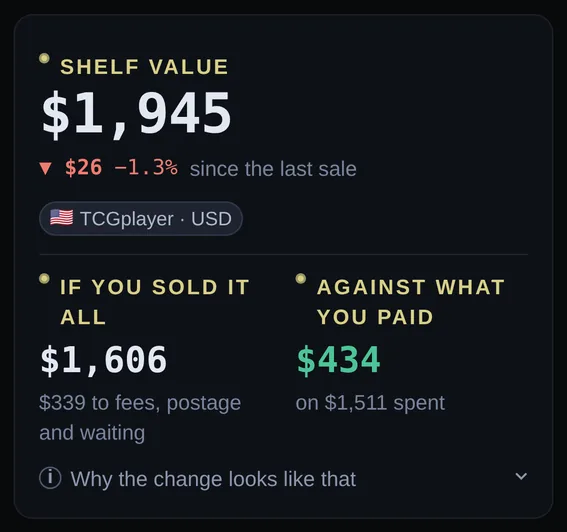
The app's shelf value panel: a total of $1,945, down $26 or 1.3% since the last sale, marked TCGplayer in US dollars, with what the collection would clear if sold and what it cost.

The catalogue, right now

  • cards you can look up
  • sets, English and Japanese
  • cards priced today
  • marketplaces, each in its own currency

Read from the catalogue as this page loads.

What it won't do

  • It won't pass a guess off as a price. The big number on a card is the figure a marketplace published, with the day it was read. Where the app estimates, it says so, and a card nobody has sold stays out of your total.
  • It won't predict your grade. The centering tool measures borders. Surface, edges and print lines decide grades too, and a photo can't see them.
  • No tracking. No analytics, no cookies, no ad networks. Without an account your collection stays in your browser.
  • Card art stays where it lives. Pictures load from the public card database, here and in the app. The names and artwork belong to their publisher.
  • Not investment advice. Forecasts come from the history on file, shown with their range, and they can be wrong.

A card's history, drawn as it happened

Every dot is one reading, placed on the day it was taken.

Where sales are far apart, the dots stay apart. A line between them would draw prices nobody paid.

The shaded band is the estimate's range. It gets wider when there is less to go on.

A year ago Today
Reading 14 of 14
A diagram of how the app draws a card with sparse sales. It shows real readings here once the app has a few months of them.

What's in it

Your shelf

Priced every day, in one currency

Add cards as you pull or buy them. The total follows the market, what you paid sits next to what the cards are worth now, and each card's change is measured against its previous sale, since most cards don't sell every day.

A card with no price in your market is counted separately and left out of the total, so it is not quietly treated as worth nothing.
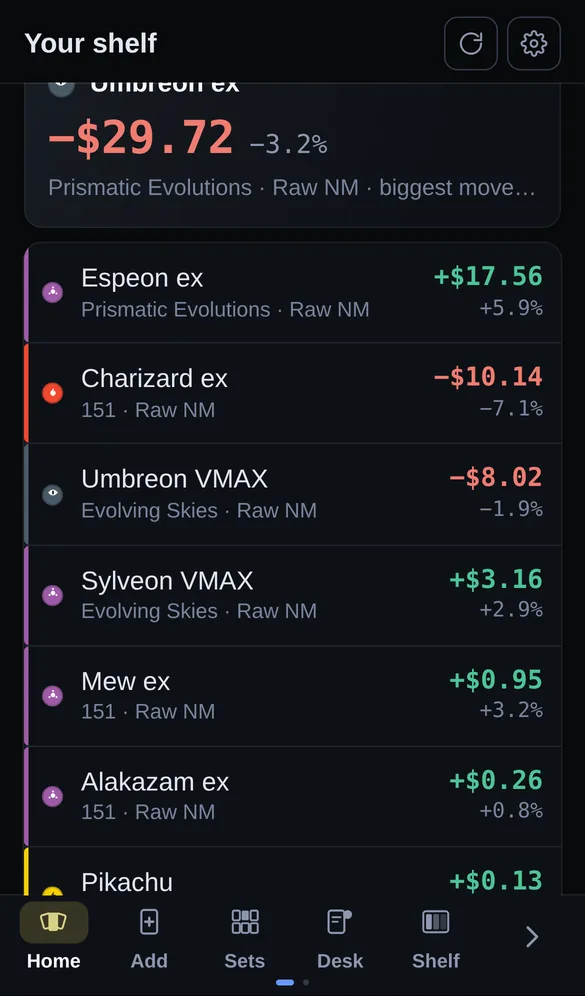
A list of cards that moved: Espeon ex up $17.56, Charizard ex down $10.14, Umbreon VMAX down $8.02, each with its set and grade.
What moved, per card, with the amount and the percentage.
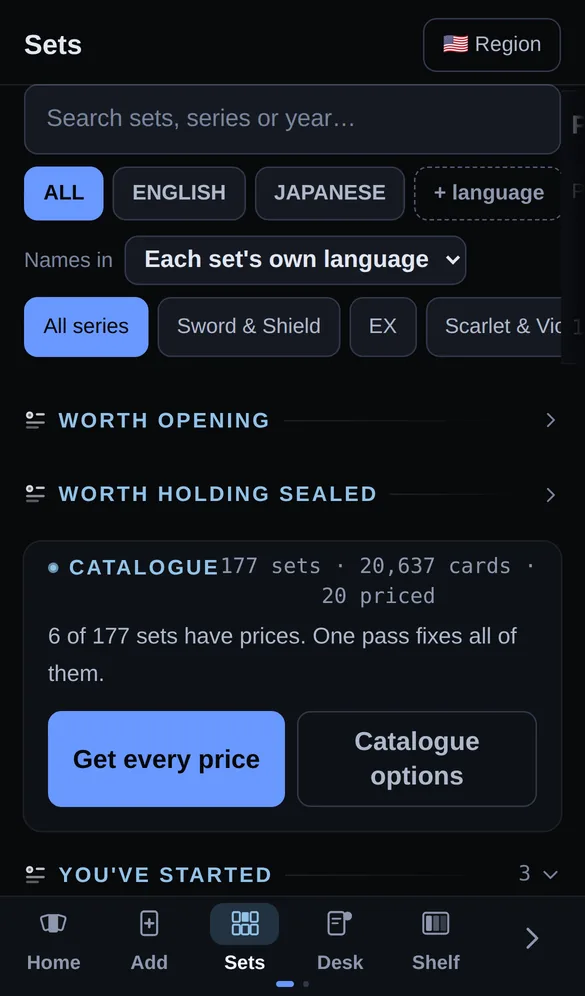
The sets screen: a search box, language filters, and an upcoming set with its release date and how many cards are confirmed.

Sets

Every set, and what finishing it costs

English and Japanese sets, how much of each you hold, and what the missing cards cost at today's prices. Announced sets are listed too, with the date and how much of the list is confirmed.

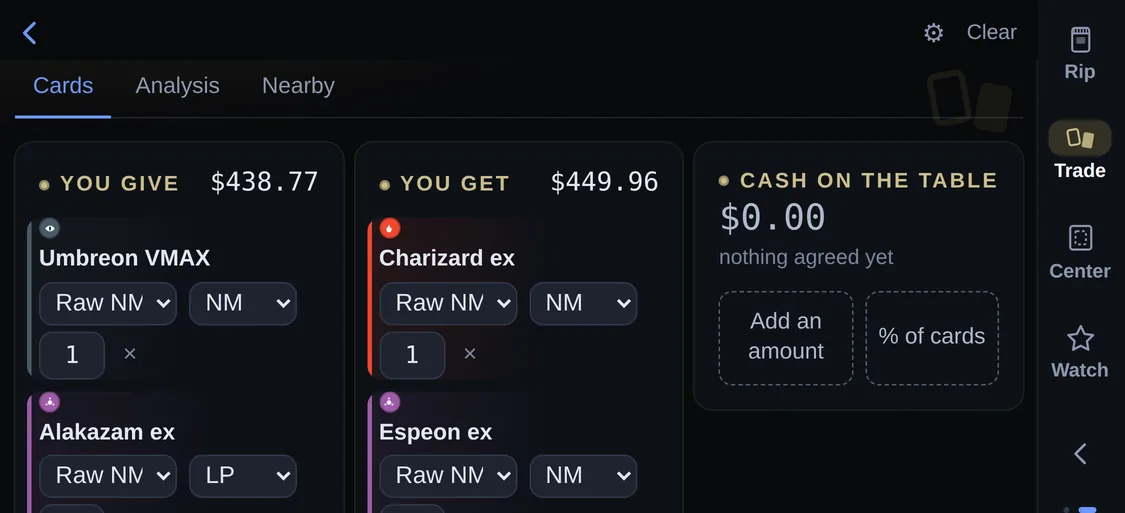
The trade screen sideways: you give $438.77, you get $449.96, with each card's grade and condition and the net if sold instead.

Trades

Both sides priced the same way

The cards you give and the cards you get are priced in one market on one day, with condition counted. It also shows what each side would clear if you sold it instead, which is the real alternative to a trade.

Display mode

Something to show people

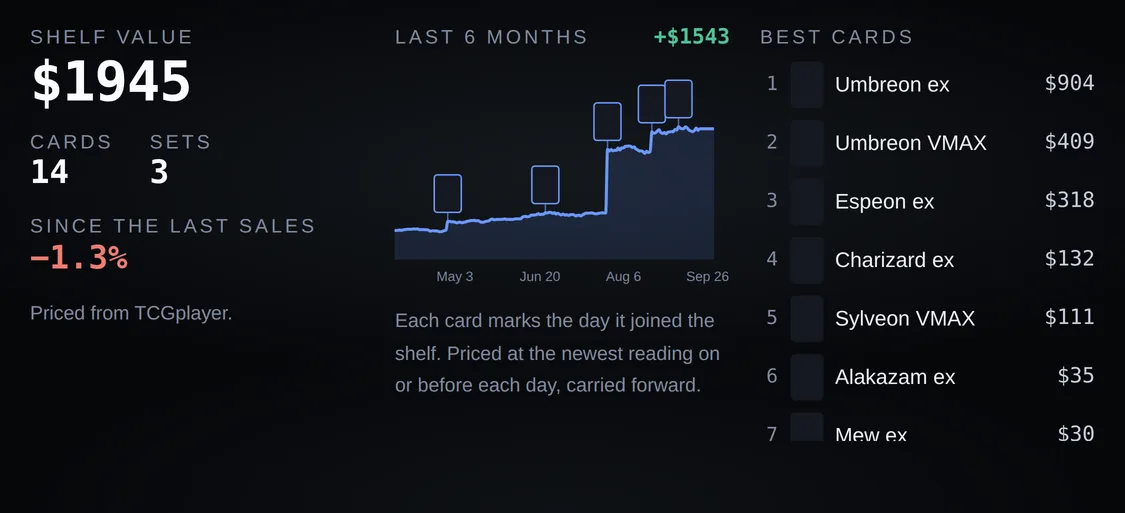
One card on the screen at a time with its grade and price. Turn the phone sideways and it adds the whole collection's value, six months of it as a line, and a thumbnail on the day each card arrived. Lock it with a short code before you hand the phone over; the lock lets go after five minutes.

Display mode's collection page: shelf value, cards and sets, a six month line of the collection's value with card thumbnails at each addition, and the best cards ranked.

Where every number comes from

The rules behind each figure ship inside the app too, on a screen called "Where the numbers come from", so they can't drift away from what the code does.

A price
The figure a marketplace published for that exact printing, with its market, its currency and the day it was read. A euro figure is a Cardmarket figure and a dollar figure is a TCGplayer figure. They are not averaged, and the gap between them is shipping, VAT and local demand, not an exchange rate.
An estimate
Worked out from the readings on file for that printing and grade, in one market, and always labelled as an estimate with its range. Where the readings are thin the range widens. A card with no readings of its own gets an estimate on its page and stays out of every total.

The full rules, including graded values and centering, in the app

Questions

Is it free?
Yes, and there is nothing to buy: no paid tier, no trial that ends, no ads and nothing sold on. If that ever had to change so the server could pay for itself, this page would say so first.
Do I need an account?
No. Without one your collection is kept in your own browser, on that one device. An account is for having the same shelf on a phone and a laptop, and whatever you added before signing up comes with you.
Does it work without a signal?
Once it is on your home screen, yes. Your shelf and the last prices it fetched are there, each with how old it is. New prices need a connection, and it tells you when it couldn't get them.
Where do the prices come from?
TCGplayer in dollars and Cardmarket in euros, each labelled with its marketplace and the day it was read. The rules are above.
Is this official?
No. It is a fan-made tool with no connection to Nintendo, Creatures, GAME FREAK or The Pokémon Company.
What happens to my collection if this project stops?
Without an account it is already on your device. With one, Settings hands you everything the server holds about you as a file, and deleting the account deletes it.

It goes on your home screen

Deskdex is a web app, so there is nothing to download. Adding it to your home screen gives it its own icon; it opens full screen, keeps your shelf and the last prices when you have no signal, and updates itself.

iPhone and iPad

  1. Open the app in Safari or Chrome.
  2. Tap the Share button, the square with an arrow coming out of it.
  3. Scroll down and tap "Add to Home Screen", then "Add".

Android

  1. Open the app in Chrome.
  2. Tap the three dots in the top right.
  3. Tap "Add to Home screen" or "Install app".

Computer

  1. Open the app in any browser. It works in a tab as it is.
  2. In Chrome or Edge, the install icon in the address bar puts it in its own window.
  3. On a Mac, Safari's File menu has "Add to Dock".

Who makes this

One collector, no company behind it.

Deskdex is written and paid for by one person who collects Pokémon cards and got tired of guessing what a shelf was worth. There is no company and no investor. It has no analytics because nobody here wants the data, and no ads because an app that tells you what your cards are worth shouldn't also be paid by somebody who wants you to buy more.

The server counts one thing: how many sessions happened each day, with no identifier attached. The privacy page says exactly what that row holds.

Found something wrong, or missing? The feedback box in the app goes straight to the person who wrote the code. Send feedback

Open it and add one card.

That is the whole trial. No account, no email, nothing to install first. If you want to see it with a shelf already in it, the sample is one tap.